In India, a woman's life story is usually told through her relationships. Somebody's daughter. Somebody's wife. Somebody's mother. When one of those labels changes or disappears, society does not know where to file her. So it files her under: problem. And then it pities her, avoids her, or tries to fix her.
She does not need fixing. She needs people to stop treating her life like a broken-down appliance.
Sochne wali baat: When did a woman become a project to be completed by marriage, only to be abandoned when the project fails?
Divorce in India still carries a weight that marriage itself rarely does. A woman who leaves a marriage - even one that was breaking her - faces more scrutiny than the man who made it unbearable. Did you try hard enough? Could you not have compromised more? What about the children? The questions never end, and they land solely on her shoulders.
The practical side is rarely discussed. Filing for divorce in India requires choosing between mutual consent (quicker, requires cooperation) and contested proceedings (longer, adversarial). Maintenance, custody, and property division - all of these require legal guidance. Free legal aid is available through the District Legal Services Authorities. Women's cells in police stations can help when domestic violence is involved.
Rebuilding financially after divorce is a specific challenge. If she left her career during marriage, re-entering the workforce is difficult. Skills go stale, and confidence erodes. The gap on the CV is questioned more than the reason behind it.
Let us be honest: Leaving a marriage that is not working takes more courage than staying. It means choosing your future over others' opinions. That is not failure. That is clarity.
Widowhood in India is its own cruelty. In many communities, a widow is still treated as though her life ended with her husband's. White sarees. No vermillion. No celebrations. Reduced to a corner of the house. This is not tradition. It is punishment for outliving someone, and it has no place in a society that claims to value women.
And then there are women who choose not to marry. Deliberately. Happily. With full awareness. And still, every Diwali, some well-meaning aunty takes their hand and says, "Koi mil jayega, tension mat lo," as though choosing yourself were a medical condition needing treatment.
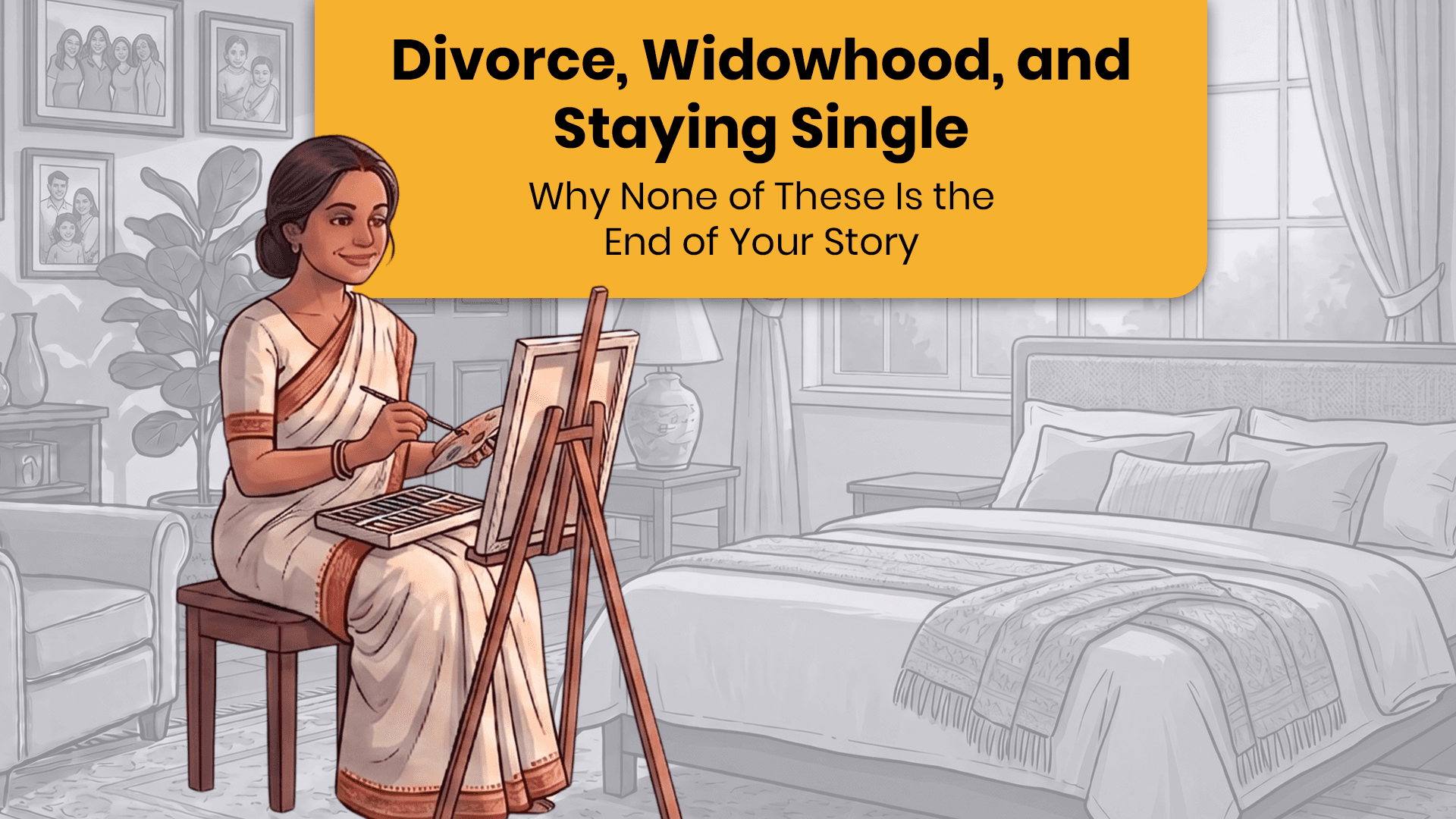
Marriage is one valid way to live, not the only one. Women who walk different paths - by circumstance or by choice - deserve the same respect, the same invitations, and the same seat at the table as those who walk the expected path.
Think about this: Your marital status is a fact of your life, not a verdict on your worth. Read that again if you need to.
A Word for Parents
If your daughter is divorced, widowed, or single by choice, she does not need you to find her a solution. She needs you to stop treating her status as a problem. The most powerful thing you can do is to live without embarrassment about her choices. When you stop apologising for her, the world gradually stops expecting you to.
Here is what stays: She is still the person you raised. Same character, same values, same heart. A missing ring does not change any of that.
TSSF team is eager to hear from you - write to us at info@sunitisolomon.org or call us at 044-28363200.
#LifeAfterDivorce #DivorceInIndia #SingleWomenIndia #Widowhood #SingleByChoice #RedefineLife #WomenEmpowerment #BreakTheStigma #MarriageIsNotEverything #LifeBeyondMarriage #IndependentWomen #SelfWorth #StartAgain #HealingJourney #NewBeginnings #OwnYourStory #WomenStrength #SocialStigma #IndianSociety #ChooseYourLife #FreedomToChoose #EmotionalStrength #ResilientWomen #UnlearnPatriarchy #DignityAndRespect #ModernIndia #WomenSupportWomen #LiveOnYourTerms #BeyondLabels #RewriteYourStory #TSSFStory