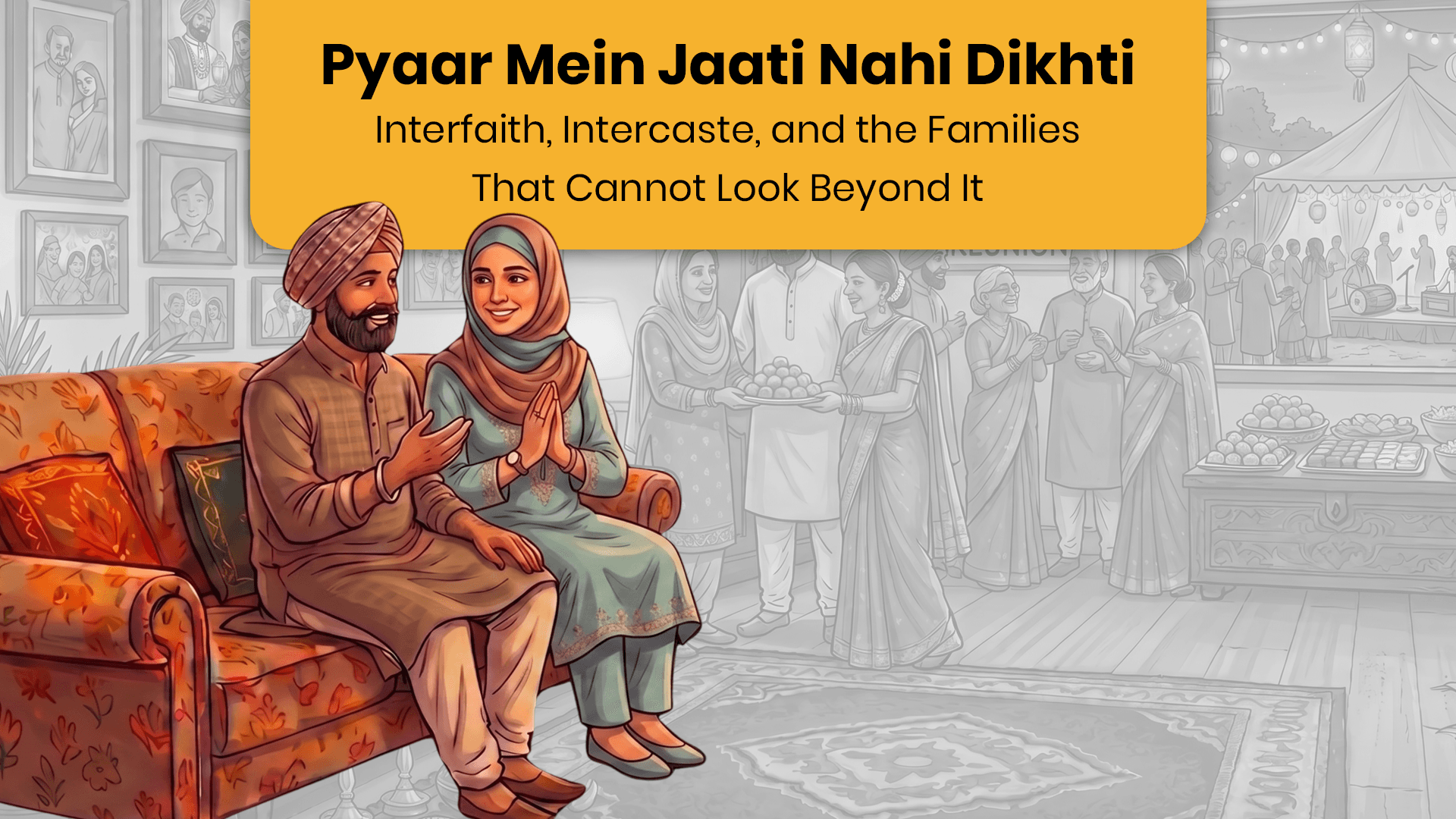
They met at work. Or at college. Or through friends of friends at a party nobody remembers. The connection was real. The feelings were mutual. Everything made sense until one question landed like a brick through a window: What is his surname? What is her background? Which community?
And just like that, love became a problem to be solved rather than a relationship to nurture.
Sochne wali baat: We teach our children to judge people by character, yet we judge their partner by caste. When did we stop hearing our own contradiction?
Intercaste and interfaith relationships in India are not unusual. They are simply rarely accepted without a fight. The opposition almost always arrives wearing the mask of love. "Hum tumhare khilaf nahi hain, tumhare liye worried hain." "Log kya kahenge?" "Tu samajh nahi rahi, yeh alag duniya ke log hain." The message beneath: your happiness is acknowledged, but it is not more important than our discomfort.
Caste has not gone anywhere. It has learned to dress better. In cities, it appears as filters on matrimonial sites. In families, it surfaces as whispered conditions over dinner. In society, it operates as the invisible sorting mechanism that nobody admits to using, yet everybody does. The young couple believes they have left it behind. Their families remind them they have not.
Ek minute ruko: If caste truly did not matter, matrimonial sites would not have a dropdown for it.
Dowry has also simply changed its form. Cars are gifted at the engagement. A flat is expected as a "gesture." A foreign honeymoon serves as proof of the bride's family's worthiness. When an intercaste or interfaith couple marries, these negotiations become even more fraught. Families are not just exchanging assets - they are deciding whether the other side deserves the exchange at all.
For couples who marry despite opposition, legal protections exist. The Special Marriage Act, 1954, allows marriage between people of any religion, caste, or community without conversion. However, the Act requires a 30-day notice period, during which objections can be raised - a provision that hostile families have weaponised. Courts have increasingly recognised adults' right to marry freely, but the gap between the courtroom and the drawing room remains vast.
And we must name the darkest corner: honour-based violence. Threats, social boycotts, forced separation, and, in extreme cases, murder - committed by families against their own children for the crime of choosing a partner across caste or faith lines. This is not a relic of the past. It happens in India today.
Think about this: When family honour demands the destruction of a child's life, it is time to re-examine whose honour is worth protecting.
A Word for Parents
If your child has chosen someone from a different background, your instinct to protect is natural. But protect them from what, exactly? From a partner who loves them? From a life they are choosing with open eyes? Or from the opinions of people whose approval you value more than your child's wellbeing?
You do not have to agree today. But shutting the door permanently means losing your child in a way no parent ever recovers from.
Ruk ke socho: Is it possible that what you are protecting is not your child but your comfort? That is a hard question, but it is also a necessary one.
TSSF team is eager to hear from you - write to us at info@sunitisolomon.org or call us at 044-28363200.
#IntercasteMarriage #InterfaithLove #LoveAcrossBoundaries #IndianSociety #CasteSystem #EndCasteDiscrimination #LoveIsLove #RightToChoose #SpecialMarriageAct #MarriageEquality #BreakTheNorms #FamilyPressure #HonourBasedViolence #StopHonourKilling #DowrySystem #ModernRelationships #ChooseLove #IndianYouth #SocialChange #EqualityInLove #CulturalBarriers #SpeakUpIndia #FreedomToMarry #HumanRightsIndia #GenderEquality #ProgressiveIndia #StandForLove #AgainstDiscrimination #RealStoriesIndia #LoveBeyondLabels #TSSFBlogs